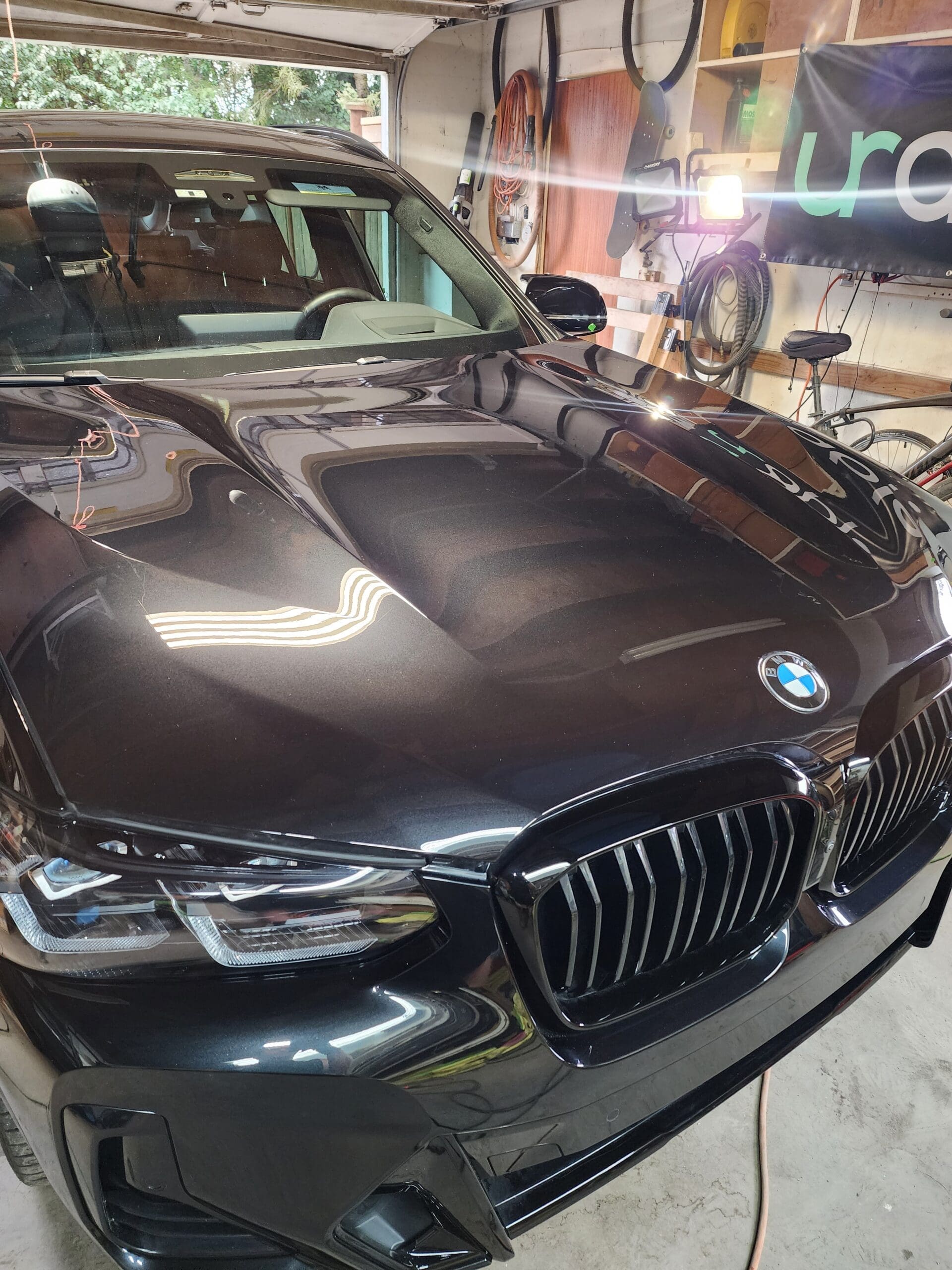
How Road Salt and Deicing Damage Car Paint in Seattle

Road contamination encompasses two distinct chemical threats that arrive simultaneously on every Pacific Northwest winter commute: road salt (sodium chloride and calcium chloride de-icers applied by WSDOT and municipal road crews) and road tar (bitumen-based compounds from asphalt operations). Both are documented causes of automotive paint and metal corrosion. Both are present on Seattle-area roads throughout the winter months.

Every Winter Commute Deposits Something Into Your Paint. Most of It You Can't See.

The Contamination Threat

Seattle's winter road treatment program is more chemical than most drivers realize. Washington State Department of Transportation and city road crews apply both solid rock salt and liquid deicing agents (including magnesium chloride and calcium chloride) to major routes including I-5, Highway 99, and the bridges throughout West Seattle and across Lake Washington. These chemicals are engineered to suppress ice formation. They are equally effective at attacking automotive paint and metal.

The damage is invisible until it isn't. By the time rust spots appear on lower panels or paint bubbling begins at the wheel wells, the chemistry has been underway for one or more winters.

What the Research Shows

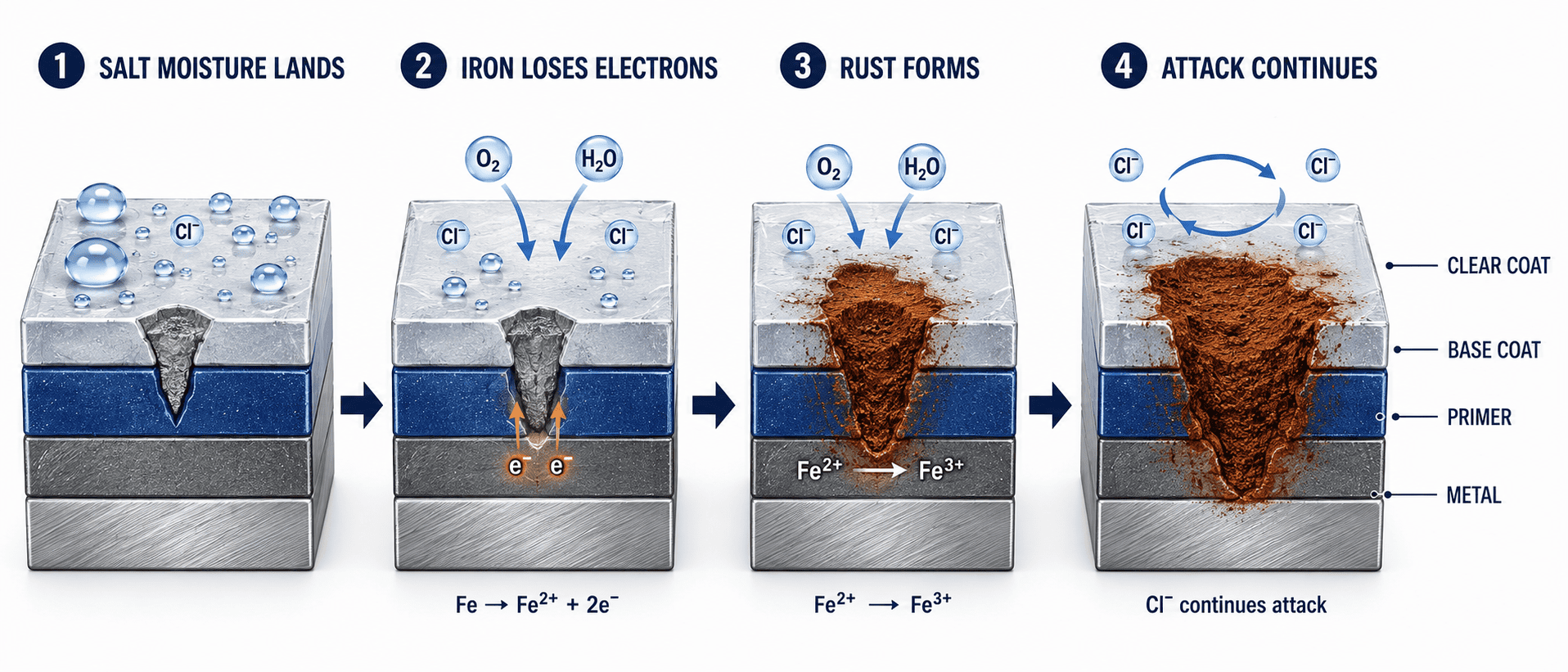
Road salt is commonly sodium chloride. Calcium chloride and magnesium chloride are also used by transportation agencies as liquid anti-icing and deicing materials. When these salts dissolve in water, they create an electrolyte: a conductive liquid that enables electrochemical corrosion on exposed metal surfaces.

On a vehicle, the risk becomes most relevant where the coating system is already compromised: stone chips, scratches, panel edges, seams, wheel wells, fastener areas, and other places where moisture and salt residue can remain trapped. Chloride ions accelerate localized corrosion by disrupting protective surface films and helping sustain the electrochemical reactions that convert iron in steel into corrosion products.

The simplified chemistry progresses from iron losing electrons to form ferrous iron (Fe → Fe²⁺), followed by further oxidation to ferric compounds (Fe³⁺) that become the familiar reddish-brown rust products. Oxygen and water are necessary participants in that process. Chloride is not consumed as the rust itself, but it makes the environment more corrosive and helps localized attack continue.
Research into deicing agent corrosion identifies both MgCl₂ and CaCl₂ as more corrosive per unit mass than NaCl due to greater hygroscopicity and higher ionic mobility at low temperatures. These compounds remain chemically active well below 0°C, continuing to attack metal and paint on the coldest Seattle nights.

The Math Working Againt Your Paint

+

Rain Days per Year

Repeated wet cycles that re-activate chloride on lower panels.

1-

UV Index Oct - Apr

Too low to cure wax — ~7 months of soft, permeable protection.

20-

Bridge Crossings

A Mercer Island → downtown commute hits salted decks all season.

Ph

Acid Rain

Pollution-laden rain pools on horizontal panels and etches clear coat.

Why Wax Can't Stop It

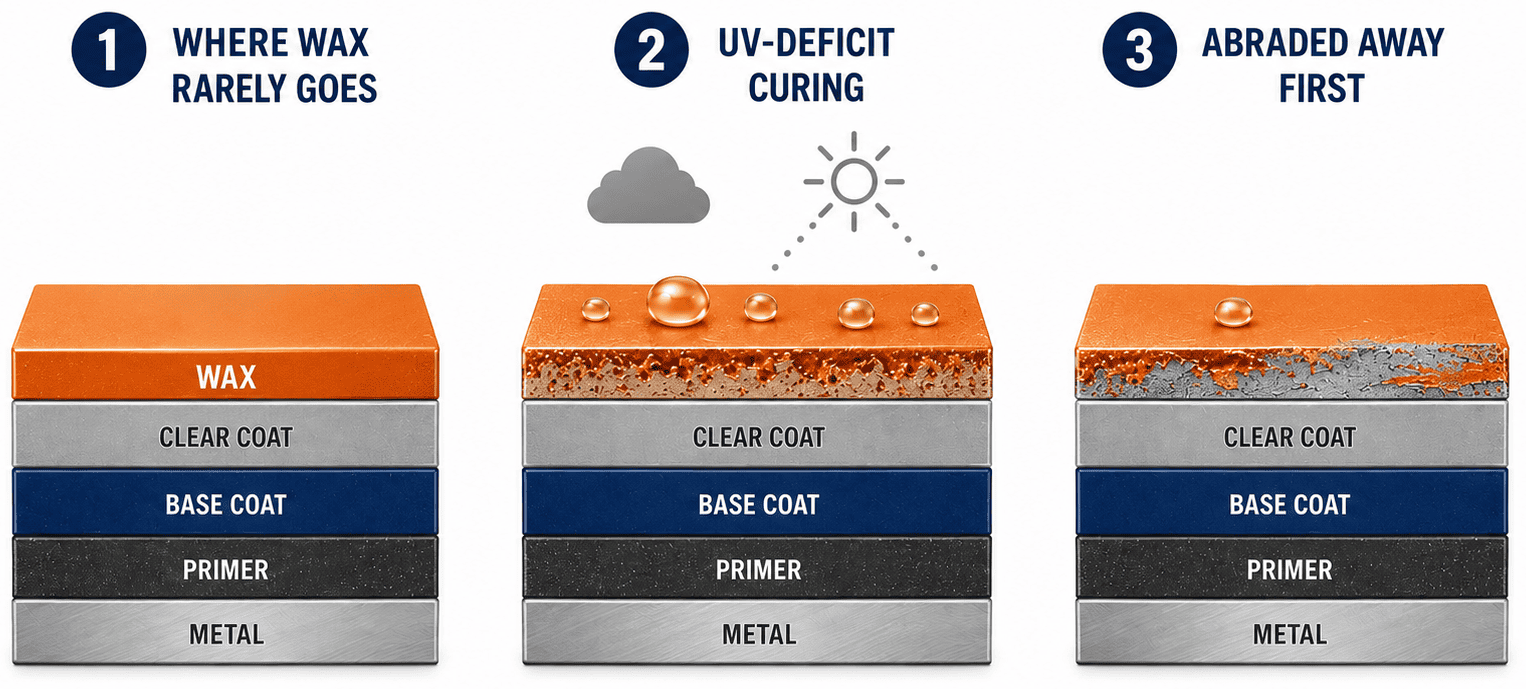
Wax can work as a barrier against salt splash, but only when it's intact, fully cured, and evenly applied. A Seattle winter breaks all three conditions at once.

Where wax rarely goes. Wax goes on the surfaces you see: hood, roof, doors. Road salt collects where you don't. It builds up on lower panels, rocker panels, and wheel wells. The areas taking the most road spray get the least wax.

UV-deficit curing. Wax needs UV to harden, and Seattle's winter sun barely delivers. A coat applied in fall, right before deicing season, may never fully cure. And uncured wax is porous, so salt brine soaks straight through it.

Abraded away first. Road grit and splash sand wax off the lower panels faster than anywhere else on the car. The wax that's protecting you from salt is the first to wear away, exactly when winter needs it most.
Look at where all three failures land: the same lower panels, rockers, and wheel wells that catch the most road spray. That's the trap with wax in a Seattle winter. The protection is thinnest exactly where the salt is heaviest. A coat that still looks flawless on your hood can be functionally gone below the beltline, and below the beltline is where the fight actually happens.

Wax was built to make paint shine and shed light contamination in fair weather. It was never meant to hold a chemical line against hygroscopic brine that re-wets itself every afternoon. So the answer to road salt isn't waxing more often. It's a surface the brine can't hold onto in the first place.
What Ceramic Coating Does
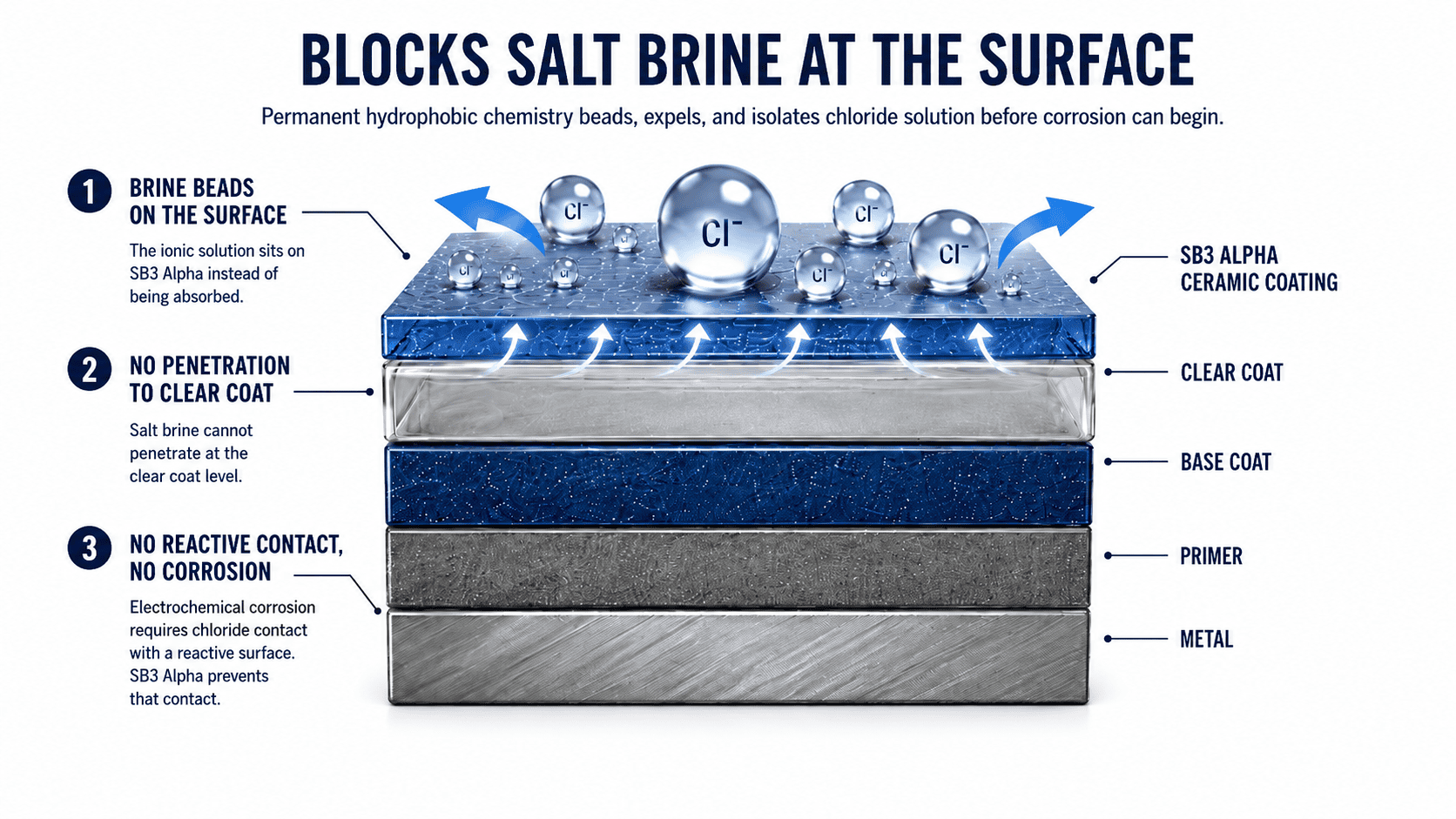
SB3 Alpha creates a permanent hydrophobic barrier that salt brine cannot penetrate at the clear coat level. The ionic solution sits on the SB3 surface and is expelled by the hydrophobic chemistry rather than absorbed into the coating. The electrochemical corrosion mechanism requires chloride ions to contact a reactive surface. SB3 provides no such surface.

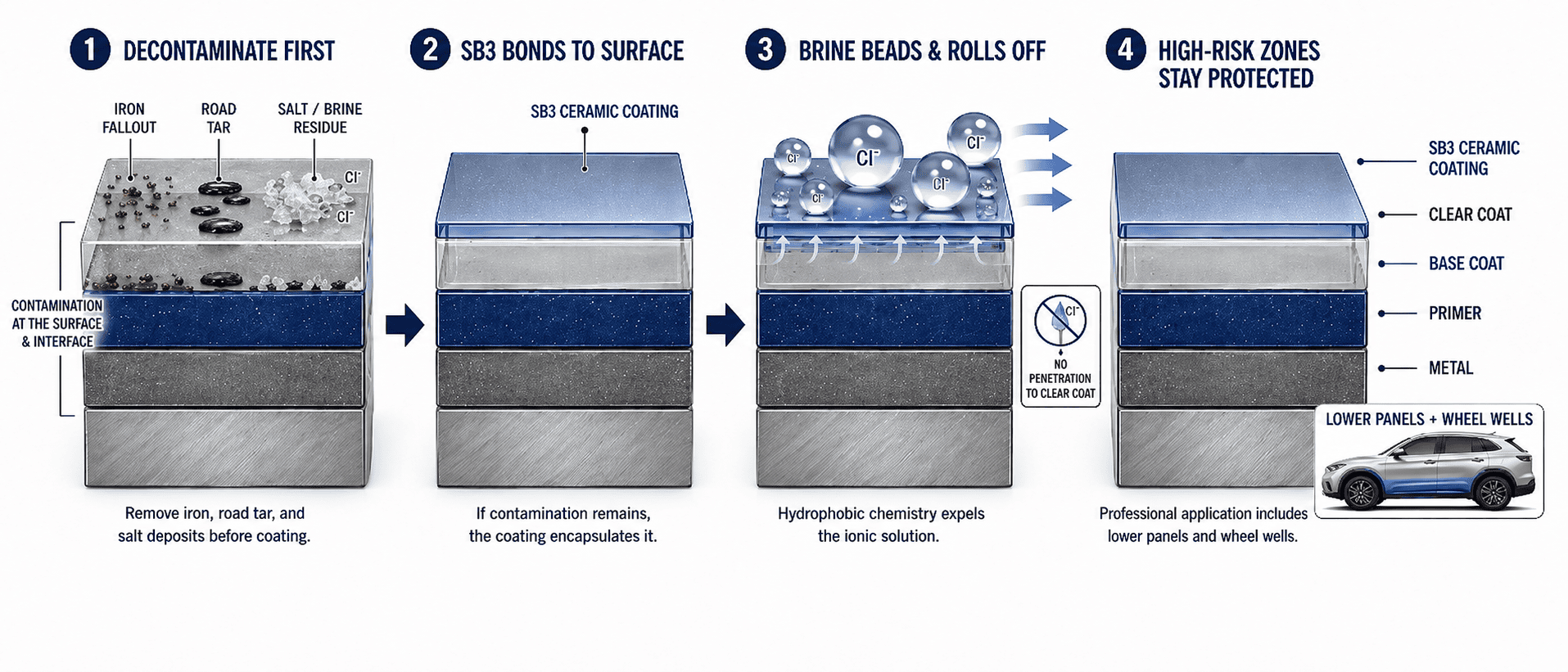
The critical prep step. Proper ceramic coating application requires addressing any existing iron contamination, road tar, and salt deposits before the coating goes on. If contamination is present at the surface-clear coat interface when coating is applied, the coating encapsulates it rather than eliminating it. This is why Diamond Fox decontaminates before every coating job. The prep sequence is not optional.

Lower panel and wheel well application. Professional application includes attention to the lower-exposure areas where road contamination concentrates. A coating that covers only the upper panels leaves the highest-risk areas unprotected. The Diamond Fox process includes these zones.
Do you commute on WSDOT-treated roads?
Ceramic coating is your best defense against road salt and deicing chemicals. It bonds to your clear coat and forms a hydrophobic barrier that keeps chloride-laden water off your paint.

What This Means For Your Neighborhood

Road contamination exposure tracks with commute corridor. Specifically, which treated bridge surfaces your vehicle crosses on a regular basis and what industrial environment surrounds your parking.

Mercer Island

One of WSDOT's highest de-icing priorities. Every Mercer Island resident who commutes via I-90 crosses a salt-treated surface twice daily during winter freeze events. The vehicle accumulates bridge-grade chloride on every exterior panel, not just the undercarriage. Over a 25-event Seattle winter season, that's a significant chloride load on unprotected paint.

Bellevue

The SR-520 crossing of Lake Washington is treated at the same WSDOT priority as I-90. Eastside commuters cross treated bridge surfaces during every winter freeze event. The floating bridge's lane configuration means every vehicle in the travel lane receives spray from adjacent lanes as well as direct surface contact.

West Seattle

Alki and Lincoln Park residents commuting via the high bridge encounter treated bridge deck surfaces during freeze events. Combined with the marine salt air these neighborhoods already see from Puget Sound proximity, the road salt exposure compounds an already aggressive salt environment.
Joe Mabel, CC BY-SA 4.0, via Wikimedia Commons
Sea Cow, CC BY-SA 4.0 — via Wikimedia Commons

SoDo / Industrial District

Road tar and road salt coexist in SoDo in concentrations not found in residential neighborhoods. Heavy freight truck traffic through the corridor generates elevated asphalt tar deposition from road surface wear, while the freight rail and port operations produce the iron fallout that compounds with chloride chemistry. Sequential chemical treatment of paint in this corridor reveals more contamination per square foot than almost anywhere else in the service area.

Explore More Ways
Seattle Damages Clear Coat

Seattle doesn't have dramatic weather. It has patient weather, which is worse for paint. 155 days of rain a year. A UV index too low to suppresses moss and bio-growth. Conifer sap dropping terpenes and rosin acids year-round. Marine salt aerosol off the Sound. All of these threats compound. Diamond Fox specializes in preventing it.
Persistent Rain
Salt ions in the moisture from the Puget Sound accelerate the electrochemical component of clear coat degradation and leave a residual deposit that traps additional humidity against the surface.
Conifer Sap
The PNW's conifer species drip resin year-round. Vehicles parked under or near these trees accumulate resin deposition that is genuinely continuous, and damaging to your vehicle's clear coat.
Airborn Fallout
Pollen is a seasonal but significant chemical threat. When pollen grains land on a vehicle surface and are exposed to moisture, they release mild organic acids, and biologically active compounds.
Freeze/Thaw Cycles
Automotive clear coat is a network of polymer. In the cold, this polymer contracts. Water trapped in micro-scratches will expand and freeze, damaging the surrounding clear coat structure.
Moss and Bio-Growth
Year-round conifer fallout and pollen give colonizing organisms their perfect food source. They live on your car's surface and create enzymes that degrade your clear coat's molecular structure.

Frequently Asked Questions

A great result starts with a clear understanding of the process. These are the questions clients ask most often before handing over their keys. We want you to feel informed, comfortable, and confident from the start.

They're the same chemical agent (chloride ions) working on different surfaces through the same mechanism. Undercarriage rust is what happens when chloride reaches uncoated or poorly coated metal and catalyzes iron oxidation directly on the steel structure. Paint panel damage from road salt requires the chloride to first penetrate through the clear coat before it reaches the metal (a longer pathway, but the same endpoint chemistry). The undercarriage has less protection between the chloride and the metal. The paint panel has the clear coat as a barrier. Both are damaged by the same commute. The undercarriage shows it faster because there's less between the salt and the metal.

Tar adhesion begins on contact and increases with time and temperature. Fresh tar thrown up by highway traffic is still partially liquid. In this state it's the easiest to address, though it still requires the correct chemical product. As the tar cools and the volatile organic compounds evaporate, the remaining residue becomes increasingly viscous and adhesive. On a dark vehicle that's been in summer sun, residual heat from the paint surface can actually re-soften tar during the commute, improving adhesion to the panel. By the time you've returned home and noticed the small dark spots on your lower panels, the tar is already bonding more firmly than when it first landed.

Rain removes loose surface dirt and some road film. It does not remove tar (which is adhesive and water-insoluble) or embedded iron from brake dust (which requires chemical treatment). For road salt specifically, rain does dilute and rinse surface salt accumulation, which is helpful before the salt dries and concentrates. But rain that carries its own acid chemistry may also activate and drive existing chloride contamination further into existing micro-damage in the clear coat. Rain is not a substitute for a deliberate post-commute rinse with fresh water, which is more effective at removing salt without contributing additional chemistry.

The highest-risk routes are the bridges: SR-520 crossing Lake Washington, I-90 crossing Lake Washington, and the West Seattle Bridge — all WSDOT high-priority de-icing surfaces. After the bridges, the highest-risk surface streets are those adjacent to the freight rail corridors: 1st Ave S through SoDo, Airport Way S through Georgetown, and the SR-99 corridor. These streets carry heavy freight traffic that generates elevated brake dust iron fallout on top of any road salt exposure. The I-5 and I-405 interchanges are high brake-dust environments due to the deceleration demands at interchange ramps.

Yes, for any commute during a freeze event. A freeze event is defined as bridge deck temperatures at or below 32°F, not necessarily visible ice. WSDOT pre-treats bridges in advance of forecast freeze events, which means bridges may be treated on days when the roads don't visibly ice. A Mercer Island resident commuting via I-90 encounters a potentially treated bridge surface on every winter commute where temperatures are near or below freezing, regardless of whether they see visible ice on the road. Over a Seattle winter, this can easily represent 20 to 30 treated bridge crossings, each depositing the highest-concentration salt load available in the service area onto the vehicle's exterior surfaces.

Location and texture are the primary diagnostics. Road tar appears as small dark or brown-black spots, concentrated on lower panels and rear-facing surfaces, and does not easily wipe off with water. It feels slightly sticky or adhesive compared to regular grit. Iron fallout is more uniformly distributed across all surfaces, feels like fine sandpaper embedded in the clear coat rather than sitting on top, and reacts visually to a pH-indicator iron fallout remover (turns red or purple). Regular road grime (dirt, organic material) is loose and releases with washing. If the "dirt" doesn't come off in a normal wash, you're dealing with tar, iron, or both.
SB3 is applied to painted surfaces: paint panels, clear coat areas, glass, and trim where appropriate. The undercarriage is a different substrate (bare metal, coated steel, plastic components, rubber) that requires different treatment products. Underbody protection (rubberized undercoating, cavity wax, wheel well liner coatings) is a separate service that addresses the most severe salt exposure surfaces on the vehicle. Both are valuable. They address different surfaces. A vehicle that benefits from SB3 on the paint would also benefit from professional underbody protection on the structural surfaces beneath. They're complementary services.

Road contamination and freeze/thaw are closely related and actively compound each other. Freeze/thaw cycling creates micro-cracks in the clear coat. Those micro-cracks are exactly the pathways through which chloride ions from road salt penetrate toward the metal substrate. Without the micro-cracks, the chloride has to work through intact clear coat, which is a slower process. With micro-cracks already present, the chloride has a direct channel. Vehicles that have accumulated freeze/thaw micro-crack damage are more vulnerable to road salt chloride penetration than intact vehicles, which is why protection applied before either threat has caused damage provides the most complete defe
DIAMOND FOX AUTO DETAIL

Explore our Services

Not every car needs the same thing. Some need a detail, some need correction, some need protection that actually holds up in Seattle, and some need all three in the right order. Explore what each service actually does and which one fits your car.

Auto Detailing

$249 starting
Financing Available
Deep cleaning, surface decontamination, and paint care. Because your ride deserves to shine.

Ceramic Coating

$1,299 starting
Financing Available
SB3 molecular protection bonded to your paint, built for what the PNW actually does to the clear coat.

Paint Correction

$349 starting
Financing Available
Swirl marks and lost depth measured, corrected, and restored. Paint depth gauge before every job.

New Car Protection

$899 starting
Financing Available
Seattle starts damaging new paint immediately. Ceramic coating protects before damage starts.
OUR CORE VALUES

The right people find Jesse.

A lot of people are searching for a quick solution. But the people who value the outcome know the difference between average work and the right hands on the job. Most people find a service. The right people find Jesse.
Precision
Precision is built through thousands of careful decisions over time. It’s knowing what matters, what doesn’t, and where exactness changes everything. When the work is done with precision, the result speaks for itself.
Integrity
You should know exactly what you’re getting and why it matters. Integrity is about being transparent, straightforward, and committed to the truth of the work. No shortcuts, no surprises, just honest service from start to finish.
Attention
Great results don’t happen by accident. They happen because someone is paying attention. From prep to final inspection, every part of the process is watched closely. That care shows up in the finish, and the confidence clients feel when it’s done.
Permanence
Permanence means building something that endures. The goal is lasting protection, lasting beauty, and lasting peace of mind for the owner. When the work is done with integrity, the results don’t just impress. They stay. That’s the Diamond Fox Standard.

Elite Level Service.
Done Right. The First Time.

For a vehicle you've invested in, ceramic coating is what separates a finish that holds up from one that fades, dulls, and demands constant upkeep.
Located in West Seattle at
7919 29th Ave SW
West Seattle, WA 98126
By Appointment Only
© 2026 Diamond Fox Auto Detail LLC. All Rights Reserved
Secret Link