How The Trees in Seattle Damage Your Car Paint

Seattle is defined by its tree canopy: Douglas fir, western red cedar, Sitka spruce, western hemlock. What most drivers don't know is that these trees drip resin continuously, not just in spring. Unlike the sap from deciduous trees, conifer resin is chemically aggressive from the moment it contacts your paint. It doesn't just sit there. It starts working immediately.

The Contamination Threat

The Douglas fir, western red cedar, and Sitka spruce that define the Pacific Northwest landscape are among the most persistent environmental threats to automotive paint in the Seattle region. While deciduous trees produce water-soluble sap seasonally, conifers drip resin year-round, and that resin is chemically aggressive from the moment of contact in ways most vehicle owners never learn about.

What the Research Shows

Conifer resin isn't like the sticky sap from a maple or a fruit tree. Its chemistry makes it a different order of threat to automotive clear coat, and a far more damaging one, because it carries three separate classes of aggressive compounds.

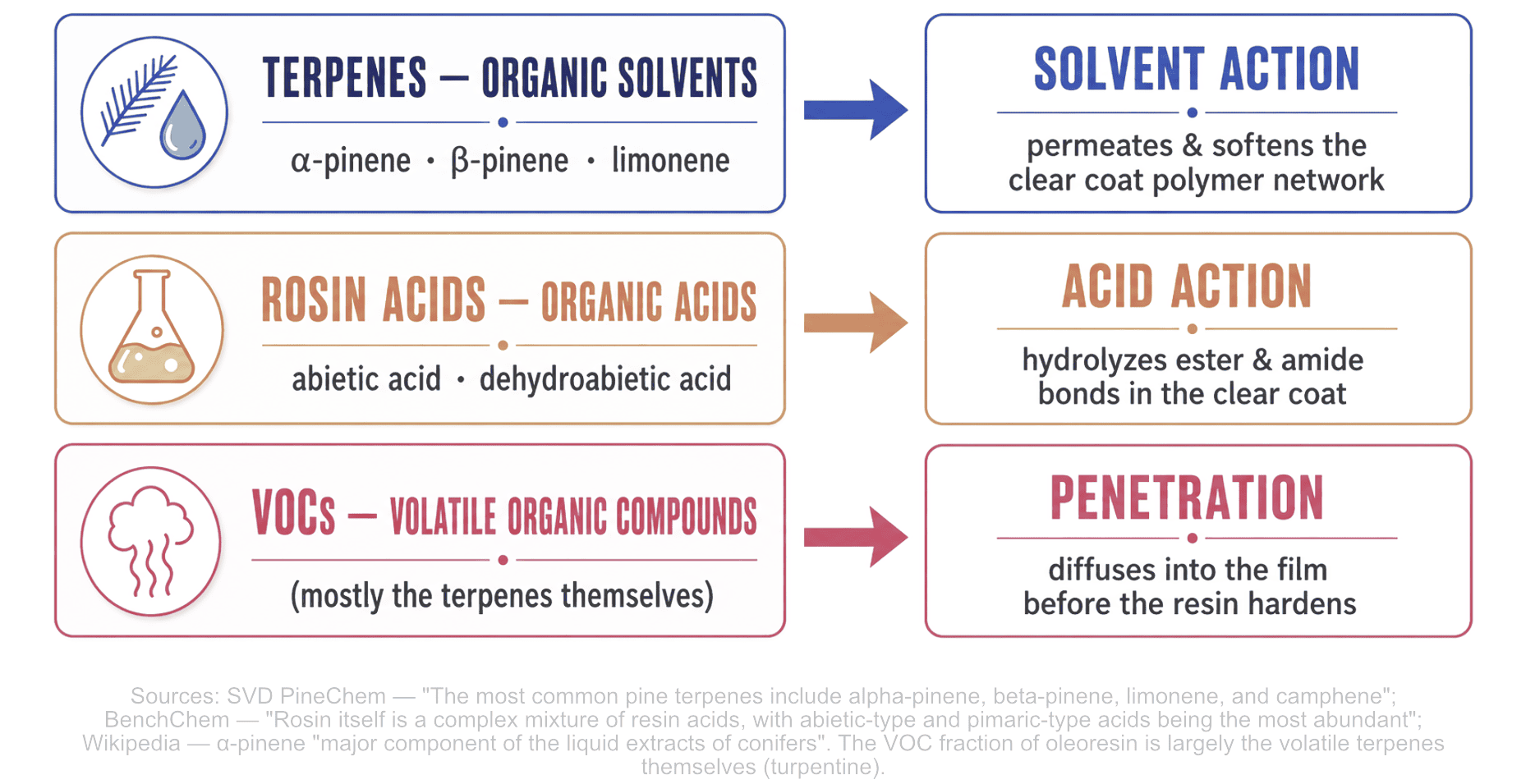
The first are terpenes, mainly α-pinene, β-pinene, and limonene, which are organic solvents. They begin permeating the clear coat from the moment the resin touches the surface, well before the sap has visibly hardened. As they work in, they soften the polymer network and make it more permeable, opening the door for everything that follows.

The second are rosin acids, abietic and dehydroabietic acid, which catalyze the breakdown of the bonds holding the clear coat together. They don't need heat or long exposure to get started. Contact is enough. Alongside them, volatile compounds in the resin penetrate the coating at the molecular level before the sap has even solidified.

What makes conifer resin especially destructive is that it doesn't just sit on the paint, it bonds to it. Fresh resin starts forming a chemical bond with the clear coat on contact, and as it polymerizes and hardens it contracts, pulling on the surface it's now anchored to. That hardened, shrinking bead also traps dirt, pollen, and heat against the paint, concentrating the attack in the exact spot where it sits.
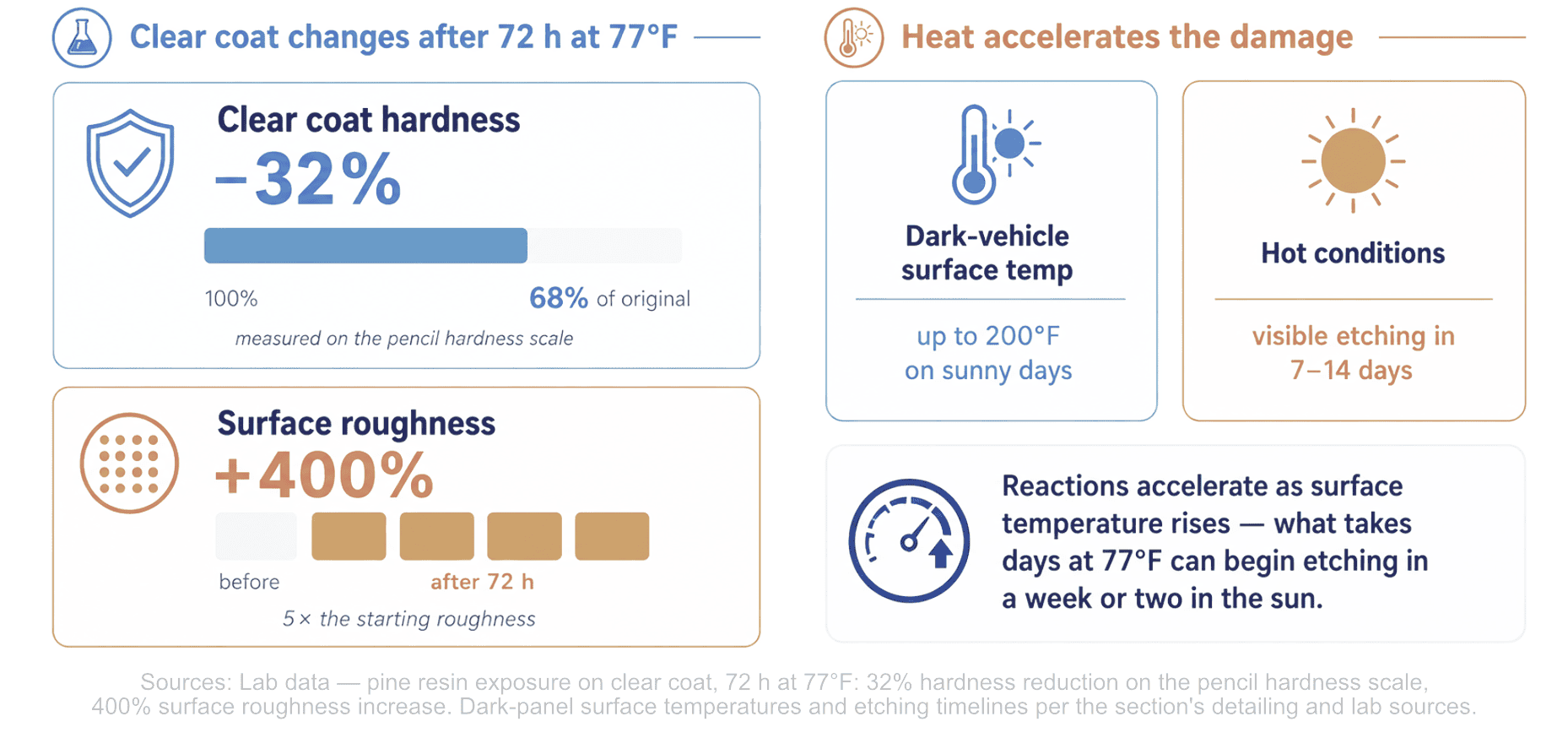
The damage is measurable. In lab testing, pine resin left on clear coat at 77°F for 72 hours cut the coating's pencil hardness by 32% and raised surface roughness by 400%. Heat accelerates all of it. On a dark vehicle, where surface temperatures can reach almost 200°F (93°C) in direct sun, the reactions speed up sharply, and visible etching can begin within 7 to 14 days.

By then, the sap can't simply be washed off. Once it has hardened and contraction-bonded to the paint, soap and water won't move it, and trying to force it off takes clear coat with it. Safe removal means softening the resin first with the right solvent, lifting it without abrasion, and then checking the paint underneath for etching that may already be there.

The Math Working Againt Your Paint

7-

Days for Etching

In hot conditions, sap can etch the clear coat in under two weeks.

Days of Conifer Drip

Conifers release resin in every season, not just spring like deciduous trees.

Hours for Damage

Hardness and roughness both change after just three days of contact.

Chemical Attackers

Solvents, acids, and VOCs each damaging the clear coat in a different way.

Why Wax Fails Here

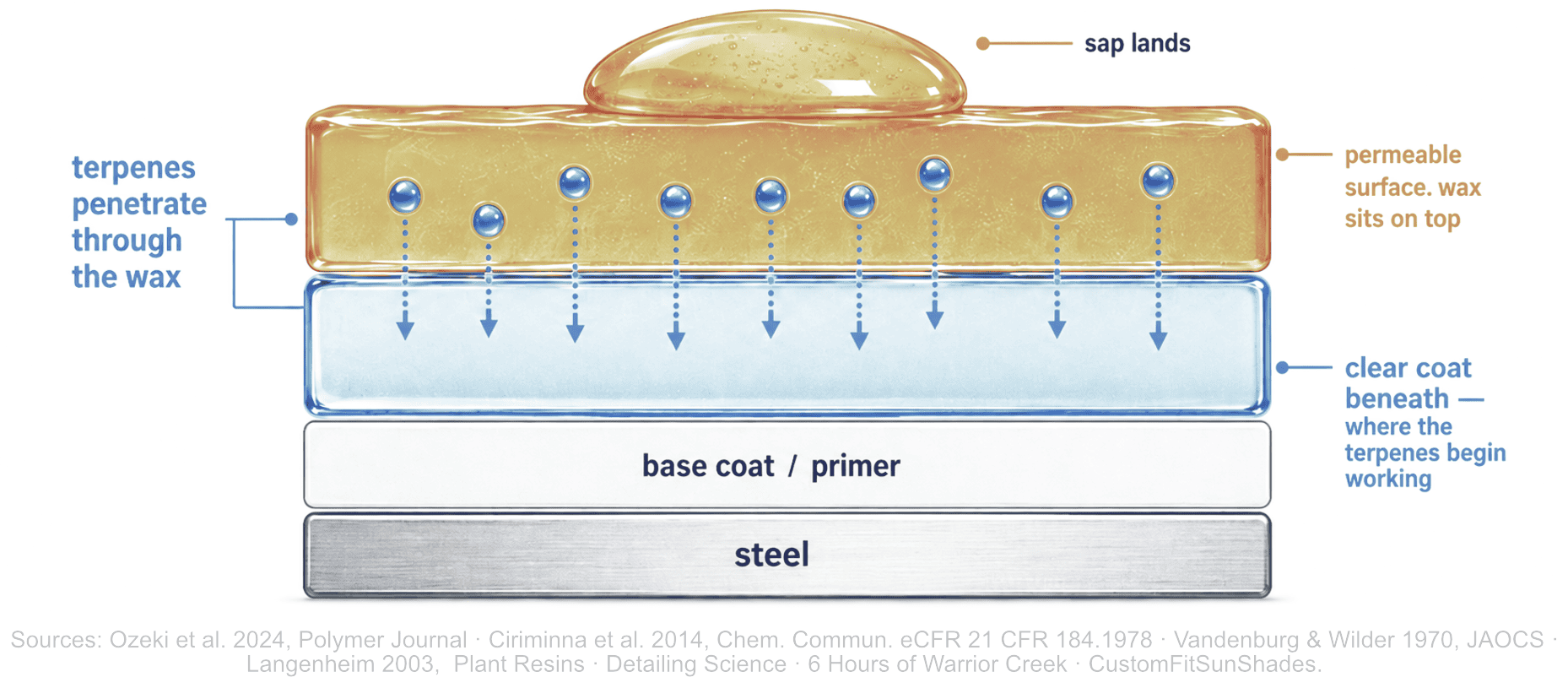
Wax offers no real defense against conifer sap, and the reason is structural. A wax coat sits on top of the clear coat rather than bonding into it. It's a thin, temporary film whose job is to bead water and add gloss, not to hold a line against solvents. So when resin lands on a waxed panel, it isn't meeting a barrier. It's meeting a film that sap chemistry is built to get through.
The chemistry isn't on wax's side. Carnauba, the wax in most premium products, is an ester, and esters dissolve in organic solvents. It resists them while cold, but its solubility climbs as it warms, which matters because your paint bakes in the sun at exactly the times sap is dripping. Conifer resin, for its part, is loaded with terpenes, and terpenes are aggressive solvents. Limonene, one of them, is sold commercially as a paint stripper and is strong enough to dissolve polystyrene foam at room temperature. Against a solvent like that, a sun-warmed wax film is not much of an obstacle.

So the terpenes work down through the wax and reach the clear coat underneath, where the real damage happens. And the wax doesn't even make the cleanup easier. Once the resin hardens into or through the wax layer, getting it off is as risky as pulling hardened sap from bare paint, because the wax is now bonded into the same mess. Whatever wax adds in shine, it adds nothing that keeps sap off the surface it's supposed to protect.
Do you park near trees often?
Ceramic coating protects against damage. It bonds directly to your clear coat, repels water instead of letting it pool, and holds up for years where wax wears out in weeks.

Ceramic Coating Protects Against Tree Sap

Everything about conifer sap damage depends on one thing: the resin forming a bond with the surface. SB3 is built to deny it that bond.

SB3 cures into a hard, cross-linked network of silicon dioxide, an inorganic ceramic rather than an organic polymer. That distinction is the whole point. The terpene solvents in conifer resin do their damage by swelling and dissolving organic polymer chains, which is exactly what an ordinary clear coat is made of. A cured ceramic gives those solvents nothing to work on, because there's no compatible polymer for them to soften or break down.

The surface itself also gives resin very little to hold onto. SB3 is engineered for low surface energy, the same property behind anti-graffiti coatings, which force resin-based spray paint to bead up instead of bonding. On a surface like that, sap can't get the chemical or mechanical grip it needs. Instead of bonding into the paint the way it does on bare or waxed clear coat, the resin sits on top of the coating, where it can be wiped or rinsed away cleanly before any etching begins. On unprotected paint, sap is damage to correct. On SB3, it's a deposit to remove.

SB3 formulations that include TiO₂ add a modest, sunlight-dependent assist. Under UV light, TiO₂ can photocatalytically break down organic compounds, and limonene, one of the main terpenes in conifer resin, is among the ones it degrades. This is a supporting effect, not the main defense. It works best in the brighter months and slows through Seattle's low-UV winter, which is fine, because the surface-energy protection doesn't depend on sunlight at all. That's what carries the load year-round: resin struggles to form the bond it needs to start doing damage, and whatever lands stays on the surface where it belongs.

What This Means For Your Neighborhood

Road contamination exposure tracks with commute corridor — specifically, which treated bridge surfaces your vehicle crosses on a regular basis and what industrial environment surrounds your parking.

Lincoln Park (98136)

The most aggressive sap environment in the cluster. Dense Douglas fir and western red cedar canopy along Lincoln Park's residential streets deposits sap year-round. Vehicles parked outside in this neighborhood face continuous resin deposition with no seasonal break. The UV deficit compounds the threat — Seattle's limited UV cannot break down early-stage terpene deposits before they begin permeating the clear coat.
Joe Mabel, CC BY-SA 4.0, via Wikimedia Commons

Mercer Island (98040)

Island geography produces canopy that traps moisture alongside the sap. Terpene compounds penetrate faster in high-humidity conditions — the moisture increases the clear coat's permeability. Mercer Island vehicles parked under conifers are dealing with the worst combination in the service area: aggressive sap chemistry in a persistently humid environment.

Bellevue (98004)

The wooded residential neighborhoods off Bellevue Way and around Clyde Hill have dense tree cover against high-value vehicles. Sap damage on the Eastside follows the same chemistry as Seattle-side — the tree species are the same. Vehicles in this corridor need the same oleophobic defense.

Queen Anne (98109)

Upper Queen Anne's tree-lined residential streets combine sap exposure with the lake fog moisture that amplifies terpene penetration. The neighborhood has lower canopy density than Lincoln Park but more year-round moisture contact than Eastside equivalents.

Explore More Ways
Seattle Damages Clear Coat

Seattle doesn't have dramatic weather. It has patient weather, which is worse for paint. 155 days of rain a year. A UV index too low to suppresses moss and bio-growth. Conifer sap dropping terpenes and rosin acids year-round. Marine salt aerosol off the Sound. All of these threats compound. Diamond Fox specializes in preventing it.
Persistent Rain
Salt ions in the moisture from the Puget Sound accelerate the electrochemical component of clear coat degradation and leave a residual deposit that traps additional humidity against the surface.
Airborn Fallout
Pollen is a seasonal but significant chemical threat. When pollen grains land on a vehicle surface and are exposed to moisture, they release mild organic acids, and biologically active compounds.
Freeze/Thaw Cycles
Automotive clear coat is a network of polymer. In the cold, this polymer contracts. Water trapped in micro-scratches will expand and freeze, damaging the surrounding clear coat structure.
Moss and Bio-Growth
Year-round conifer fallout and pollen give colonizing organisms their perfect food source. They live on your car's surface and create enzymes that degrade your clear coat's molecular structure.
Road Contamination
Road salt, primarily sodium chloride, with calcium chloride and magnesium chloride used as liquid pre-treatment and anti-icing agents, creates a corrosive brine when it contacts moisture.

Frequently Asked Questions

A great result starts with a clear understanding of the process. These are the questions clients ask most often before handing over their keys. We want you to feel informed, comfortable, and confident from the start.

Run your fingertip across the area after washing. Healthy clear coat feels glassy and uniform. A surface that has been chemically etched by sap feels slightly rough (like fine-grit sandpaper against your fingertip) even after washing. In direct sunlight or with a detailing light at a low angle, you'll see a hazy, dull, or mottled appearance in the affected area rather than a clean reflection. If you're seeing either of those things, the clear coat has already been compromised and a paint correction assessment is the right next step.

Yes, but it's shorter than most people expect. Fresh resin that landed within the last few hours and has not yet polymerized can sometimes be lifted cleanly with an isopropyl alcohol solution and a soft microfiber cloth, using gentle blotting rather than wiping. The moment the resin begins to cross-link and harden (which happens faster in warm conditions and slower in the cool PNW climate), removal risk increases sharply. The safest general rule: if you can see it and it's still soft, address it the same day. If you're not sure whether it's hardened, don't force it.

Household solvents are either too aggressive or too weak, and the difference between those two failure modes isn't obvious until after the damage is done. Products like Goo Gone contain petroleum distillates that can strip protective coatings and introduce their own chemical environment to already-compromised clear coat. High-concentration rubbing alcohol can cause clear coat hazing or marring if the surface is already softened by terpene penetration. Detailing-grade solvents are formulated to dissolve resin specifically, at concentrations tested against automotive clear coat chemistry. The tool matters as much as the knowledge.

No, and the misconception causes more damage than the sap itself. Rain may dilute fresh, very soft resin slightly, but it does nothing to stop terpene penetration, which occurs at the molecular level regardless of moisture. Once the resin begins to polymerize, rain actually worsens the situation: the water fills the surface micro-roughness created by the sap chemistry, and the combined contaminant (hardened resin plus mineral-laden runoff) becomes more difficult to remove safely. Seattle's frequent rain makes people feel like the environment is self-cleaning. It isn't.

Garage storage eliminates overnight accumulation and dramatically reduces your total exposure. But most vehicles spend eight or more hours per day parked outside: at work, at school, at a grocery store, at a trailhead. Sap doesn't require overnight parking to create a problem. A single afternoon parked under a Douglas fir in a strip mall lot in Burien is enough exposure for resin to land, begin bonding, and start the terpene penetration process before you get back. Where you park during the day matters as much as where you store the car at night.

On dark paint (black, navy, dark gray), sap etching shows as raised or dimpled areas in the clear coat that catch light differently than the surrounding surface. You'll see small, irregularly shaped dull spots or slight shadows at low angles. On light paint (white, silver, pearl), the visual signature is different: the roughened surface doesn't create obvious dark contrast spots, but appears as a faint haze or loss of clarity in reflected images. The chemistry is identical. The presentation is different. Light-colored vehicle owners often discover sap damage later because the visual cue is subtler, which typically means more damage has accumulated before anyone investigates.
It depends on the depth of the damage. Clear coat has measurable thickness, typically 40 to 80 microns on modern vehicles. If the terpene chemistry and rosin acid hydrolysis have etched the surface within the upper portion of that thickness, paint correction can remove the damaged layer and restore a clean, smooth surface. If the etching has penetrated deeply, particularly on vehicles with thinner factory clear coat or on dark vehicles that have been through many cycles of washing and light polishing, the damage may be too deep for correction without risking cut-through. A paint thickness gauge measurement at the affected areas is the only way to know which situation you're in. This is what the vehicle assessment is for.

For vehicles parked under or near conifers in neighborhoods like Lincoln Park, Mercer Island, or upper Queen Anne, a decontamination service once or twice per year is the minimum. Spring and early fall are the highest deposition periods: spring because warming temperatures trigger sap flow, fall because the trees are stressed before winter. But because Pacific Northwest conifers drip year-round, twice a year is a floor, not a ceiling. Unprotected vehicles in high-canopy areas should be assessed for resin contamination every time they come in for any service.
DIAMOND FOX AUTO DETAIL

Explore our Services

Not every car needs the same thing. Some need a detail, some need correction, some need protection that actually holds up in Seattle, and some need all three in the right order. Explore what each service actually does and which one fits your car.

Auto Detailing

$249 starting
Financing Available
Deep cleaning, surface decontamination, and paint care. Because your ride deserves to shine.

Ceramic Coating

$1,299 starting
Financing Available
SB3 molecular protection bonded to your paint, built for what the PNW actually does to the clear coat.

Paint Correction

$349 starting
Financing Available
Swirl marks and lost depth measured, corrected, and restored. Paint depth gauge before every job.

New Car Protection

$899 starting
Financing Available
Seattle starts damaging new paint immediately. Ceramic coating protects before damage starts.
OUR CORE VALUES

The right people find Jesse.

A lot of people are searching for a quick solution. But the people who value the outcome know the difference between average work and the right hands on the job. Most people find a service. The right people find Jesse.
Precision
Precision is built through thousands of careful decisions over time. It’s knowing what matters, what doesn’t, and where exactness changes everything. When the work is done with precision, the result speaks for itself.
Integrity
You should know exactly what you’re getting and why it matters. Integrity is about being transparent, straightforward, and committed to the truth of the work. No shortcuts, no surprises, just honest service from start to finish.
Attention
Great results don’t happen by accident. They happen because someone is paying attention. From prep to final inspection, every part of the process is watched closely. That care shows up in the finish, and the confidence clients feel when it’s done.
Permanence
Permanence means building something that endures. The goal is lasting protection, lasting beauty, and lasting peace of mind for the owner. When the work is done with integrity, the results don’t just impress. They stay. That’s the Diamond Fox Standard.

Elite Level Service.
Done Right. The First Time.

For a vehicle you've invested in, ceramic coating is what separates a finish that holds up from one that fades, dulls, and demands constant upkeep.
Located in West Seattle at
7919 29th Ave SW
West Seattle, WA 98126
By Appointment Only
© 2026 Diamond Fox Auto Detail LLC. All Rights Reserved
Secret Link