What the Research Shows
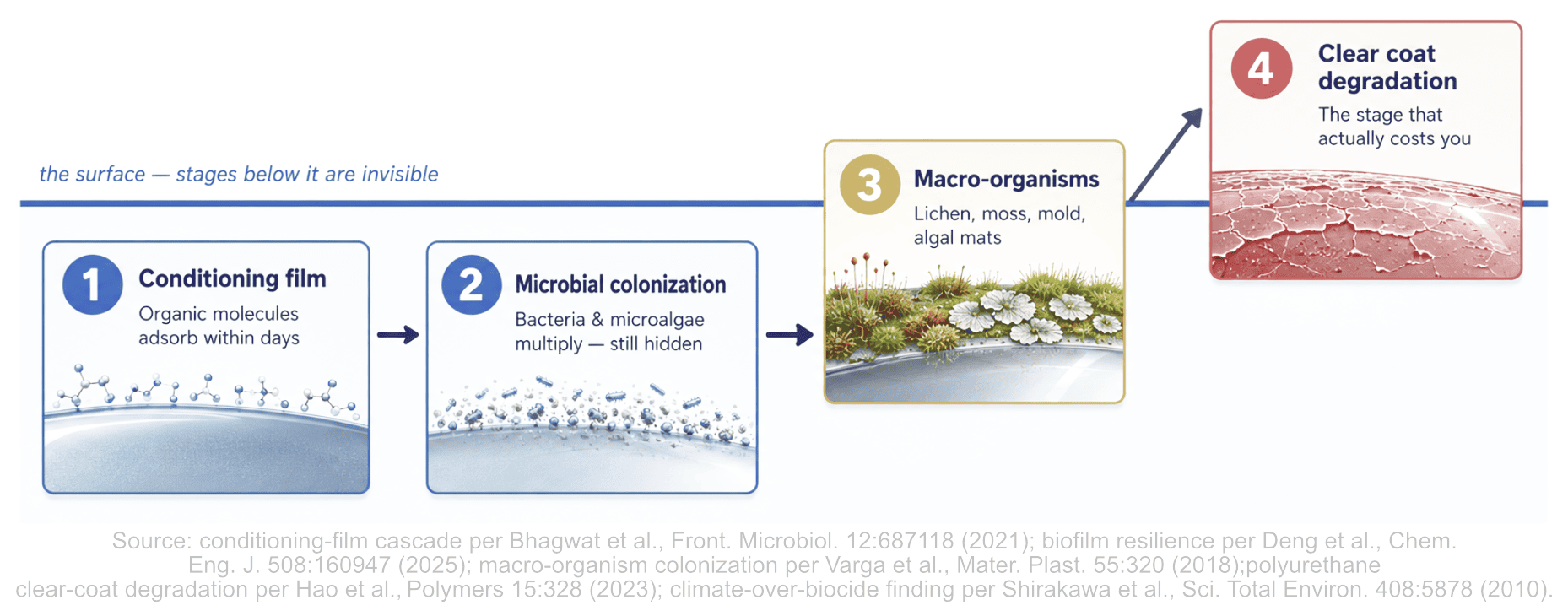
Biological growth is not a stain that lands on your paint. It is a process that builds on it, and it starts with a film you cannot see. Dissolved organic matter from the Seattle environment, sap residue, pollen, road grime, and bird waste, adsorbs onto the paint and forms what researchers call a conditioning film. A 2021 study in Frontiers in Microbiology (Bhagwat et al.) defines it plainly: conditioning films are "surface coatings formed by the adsorption of biomolecules from the surrounding environment that can modify the material-specific surface properties and precedes the attachment of microorganisms." The film does no visible harm on its own. It is the groundwork, and on an unprotected surface in this climate it begins forming within days of the last wash.

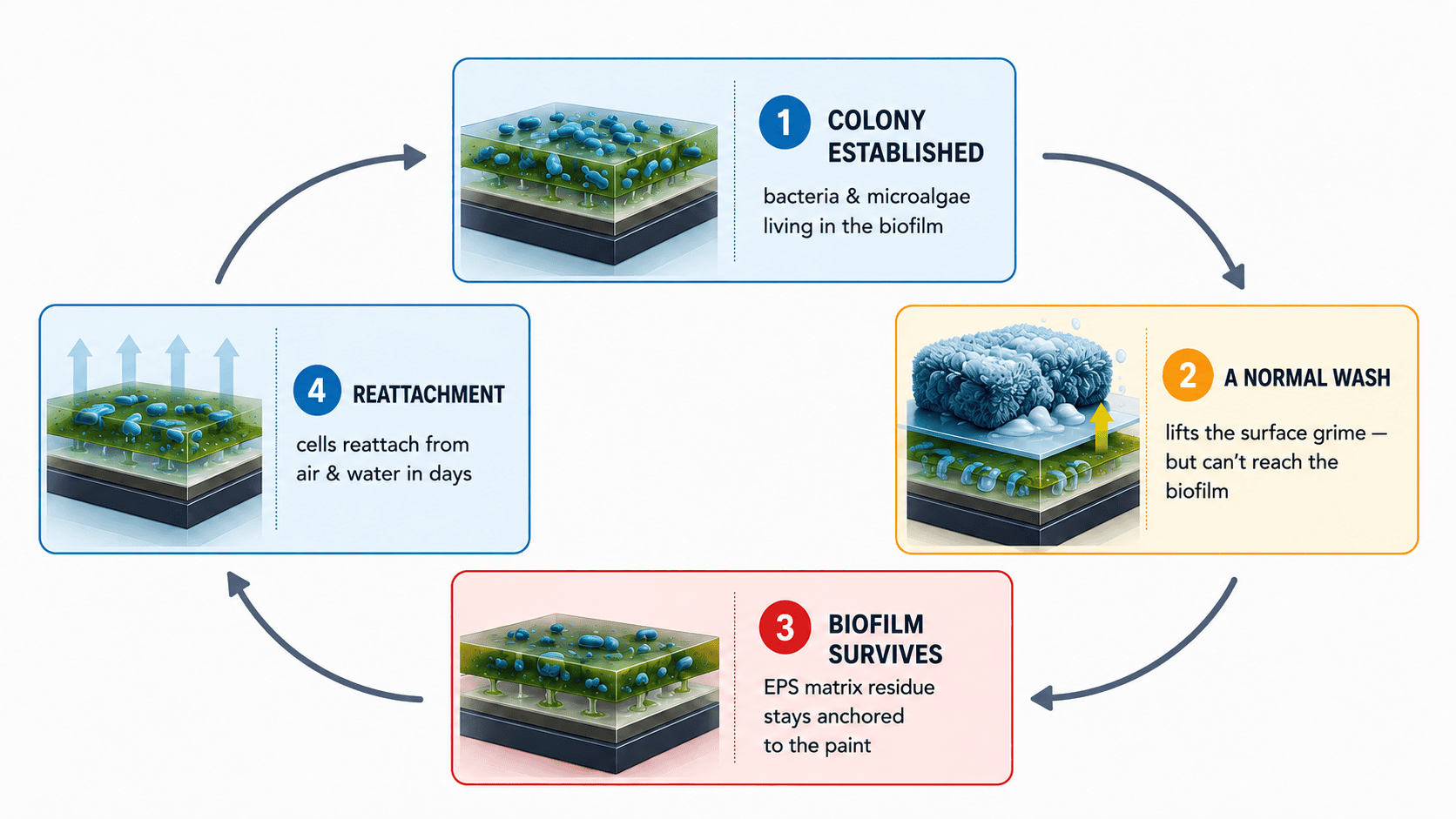
Once the film is down, the organisms arrive. Bacteria and microalgae attach to it and begin to reproduce, active but still invisible. This is where routine washing gives a false sense of security. A wash lifts the surface cells, but it leaves the biofilm matrix behind, and the film regrows from what remains. You are removing the symptom while the system that regenerates it stays in place.
Only later does any of this surface. Lichens, moss, mold colonies, and algal mats build on the biofilm base and eventually appear as green or grey-green discoloration, concentrated on the horizontal panels, the hood, roof, and trunk, where moisture and organic debris collect. By the time the color shows, the groundwork beneath it has been established for far longer.
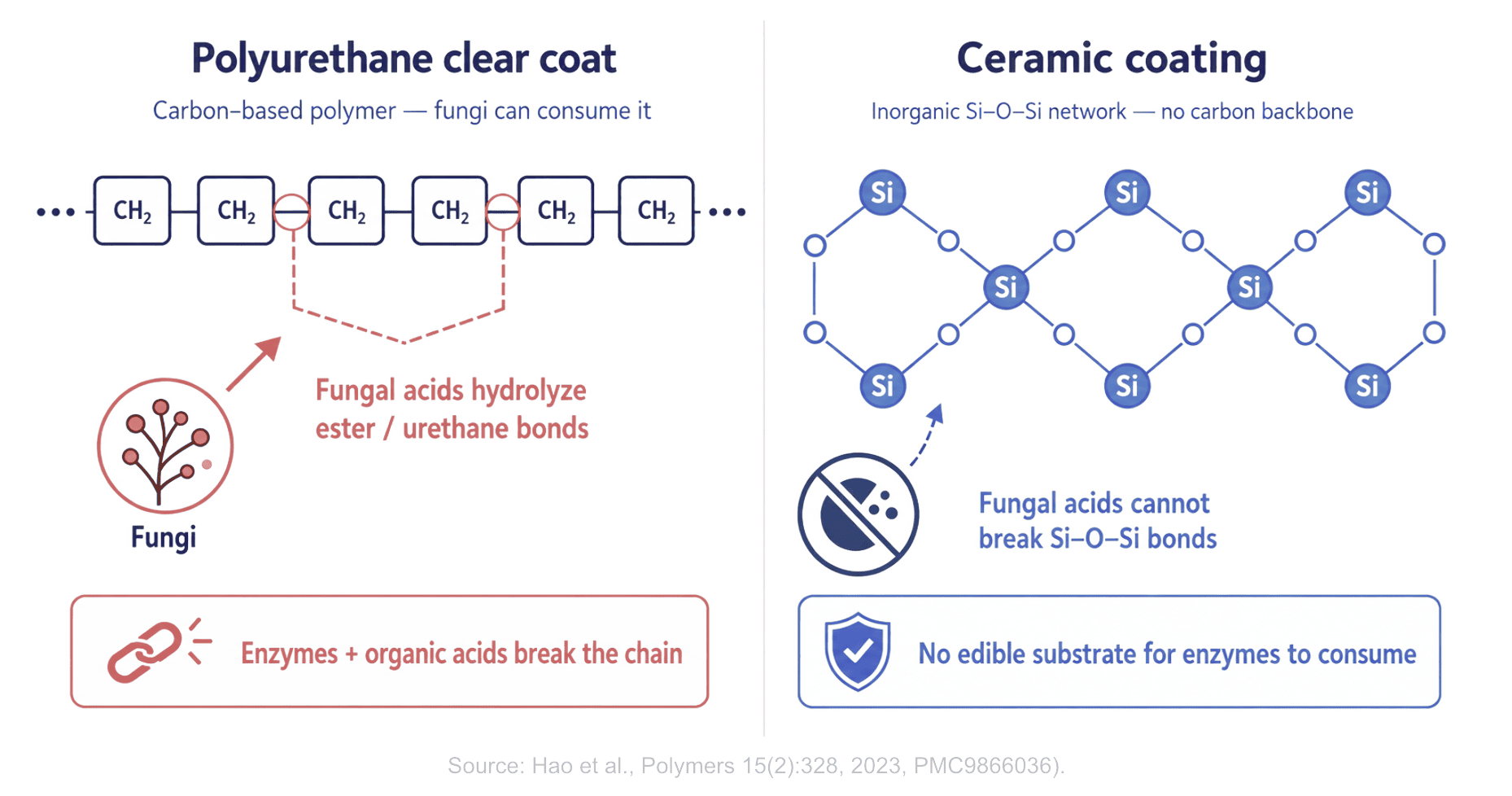
The stage that matters is the one that reaches the clear coat, because automotive clear coat is polyurethane, and polyurethane is something fungi can consume. A 2023 study in Polymers (Hao et al.) tested two fungi on polyurethane coatings and was blunt about the result: "fungi contribute significantly to the failure process of PU coatings by using PU as a carbon resource for its reproduction." The chemistry is specific. The fungi secrete carboxylic acids that "accelerated the hydrolysis of the ester and urethane bonds in the PU coatings," while their mycelia physically penetrate the coating down to the substrate. Chemical attack and physical penetration reinforce each other, and each round of damage opens fresh ground for the next.
None of this requires a harsh climate. A field study of a painted railway bridge (Varga et al., Materiale Plastice, 2018) documented lichens, the molds Aspergillus fumigatus and Aspergillus niger, algae, and moss colonizing the painted steel within a few years of repainting. And the deciding factor is climate itself. The central finding of a 2010 study in Science of the Total Environment (Shirakawa et al.) is that climate, not the biocide in the paint, is "the most important factor determining anti-fungal biocide performance in paint films." Irradiance, humidity, and temperature govern whether growth takes hold. In a low-UV, high-humidity place like the Puget Sound, the sunlight that would passively suppress colonization is simply missing. Seattle's mild, wet, dim winters do not protect your paint from biological growth. They are close to ideal conditions for it.