Seattle Doesn't Freeze Hard. It Freezes and Thaws Repeatedly. That's Worse

Seattle sees approximately 25 sub-freezing nights per year. That number sounds modest compared to inland or northern climates. The damage mechanism, however, is not driven by how cold it gets. It's driven by how many times temperatures oscillate across the freezing threshold. Freeze once and stay frozen, and the stress is linear. Freeze, thaw, refreeze, thaw again across a Seattle winter, and the stress is cumulative and compounding.

Every Winter Commute Deposits Something on Your Paint. Most of It You Can't See.

Seattle's Thermal Profile

When people think of winter paint damage, they picture the Great Lakes or Minnesota, weeks of sustained below-zero temperatures, cars buried under snow, heavy road salt. Seattle seems mild by comparison. What they don't realize is that the damage mechanism for paint is not driven by how cold it gets. It's driven by how many times the temperature crosses the freezing threshold in both directions.

Seattle sees approximately twenty-five sub-freezing nights per year. These nights experience 40–60 freeze-thaw cycles annually. Nights that drop below 32°F followed by afternoons that climb above it. Each crossing of that threshold is a mechanical stress event for every material on your vehicle's exterior. Wax cracks under thermal cycling. Micro-fractures in the clear coat propagate under the freeze-expansion of trapped moisture. Road salt that was inert when dry becomes actively corrosive when it thaws.

Freeze once and stay frozen, and the damage is one event. Cycle fifty times through a Seattle winter, and the stress is cumulative and compounding.

What the Research Shows

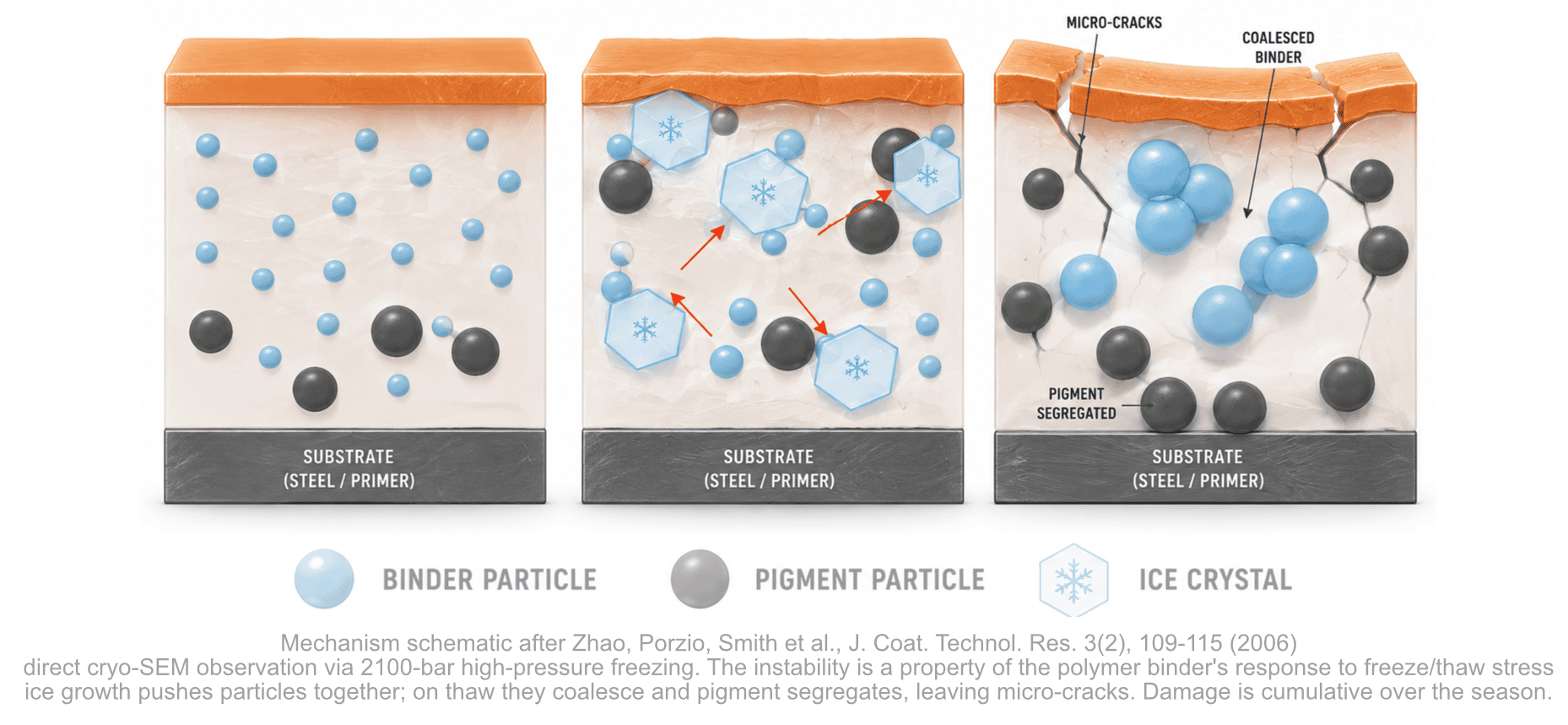
The 2006 cryogenic scanning electron microscopy (SEM) study published in the Journal of Coatings Technology Research established the mechanism precisely: freeze/thaw cycling in polymer-based coatings drives ice crystal formation during freezing. The crystals cause particle coalescence and pigment segregation that are physically disrupting to the coating's microstructure. The study showed that this instability is a property of the polymer binder's response to the freeze/thaw stress, not simply a temperature exposure problem.
Freeze/thaw damage starts with movement most people never notice. Vehicle metal expands when it heats and contracts when it cools, and the clear coat has to flex along with it. When it can't, it begins to let go at the coating-to-substrate interface. Wax and polymer sealants are especially prone to this kind of delamination, and no single cold night is to blame. The damage is cumulative, with each cycle adding a little more stress until the bond starts to fail.

As that stress repeats, it opens micro-cracks in the clear coat. They're usually too fine to see, but they change how everything else interacts with the surface. Sap, iron particles, and road salt all find footholds in a cracked finish that they could never get on an intact one.

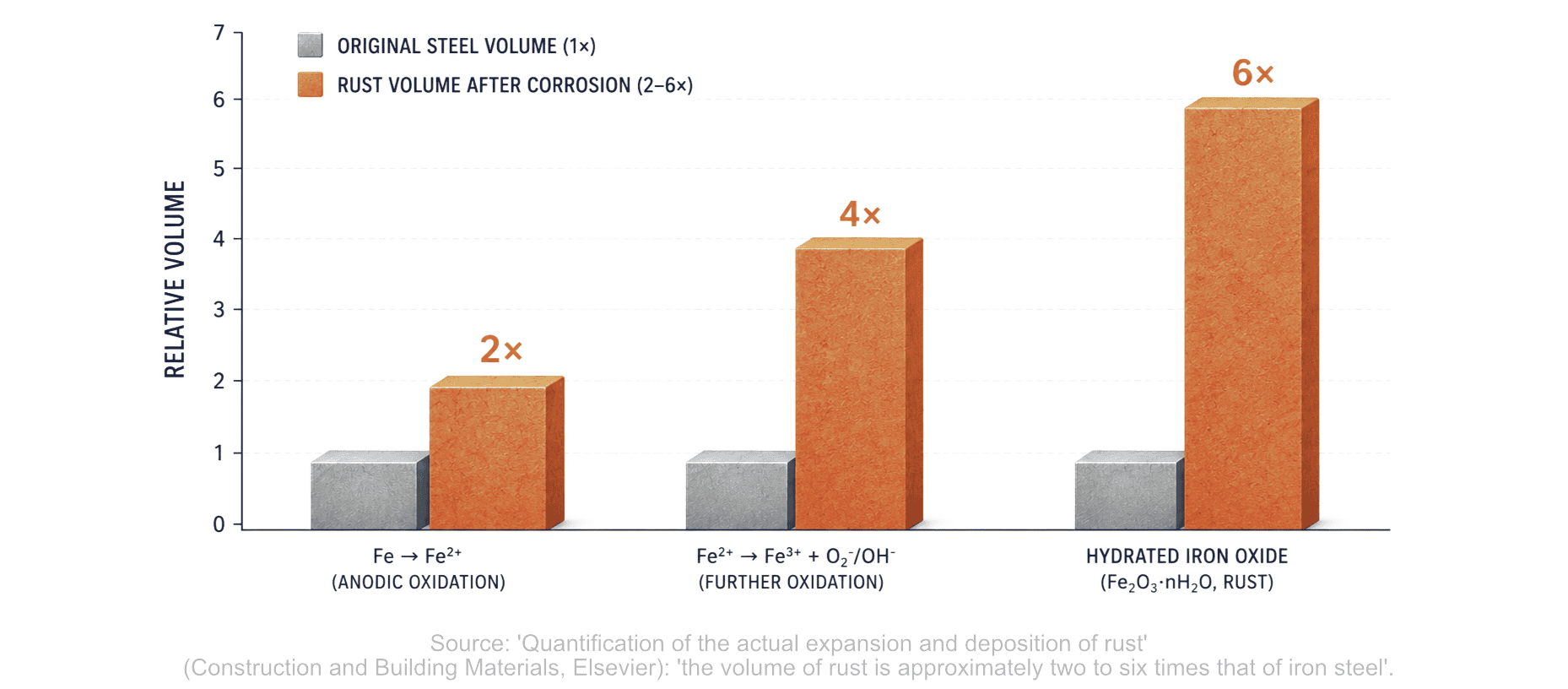
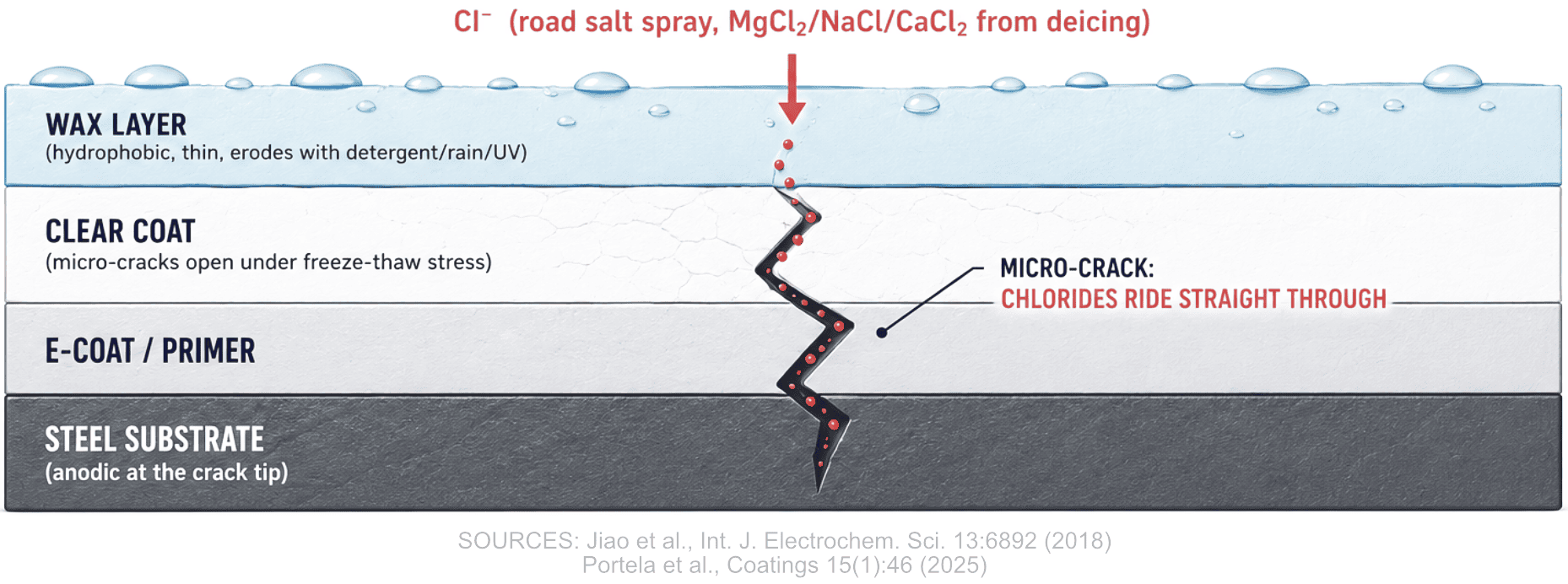
Road salt is where this turns serious in Seattle. During freezing events, WSDOT treats bridges, highways, and arterials with sodium chloride and calcium chloride de-icers, and chloride ions are small and highly mobile. They slip into those micro-cracks and work their way down to the metal, where chloride catalyzes electrochemical corrosion and accelerates the oxidation of steel (Fe → Fe²⁺ → rust). Because rust takes up more volume than the metal it replaces, it pushes back against the paint from below, adding a second source of stress to the one that opened the crack in the first place. It becomes a loop: cracks let the salt in, the salt drives rust, and the rust widens the cracks.

The scale isn't trivial. Chloride de-icers are blamed for roughly $5 billion a year in vehicle and infrastructure corrosion across the U.S., and for a car that regularly crosses treated routes like I-90, SR-520, I-405, and the West Seattle Bridge, that exposure builds up quickly over a winter of repeated freeze/thaw cycles.

Bridges deserve their own mention, because they get treated first. WSDOT prioritizes de-icing on bridge decks, so you can pick up salt crossing the water even when your own street is bare and dry. For Mercer Island residents, Eastside commuters, and anyone regularly crossing Lake Washington, treated bridge surfaces are just part of the winter commute.

The Math Working Against Your Paint

+

Sub-Freezing Nights

Every year. That's how often the expand-and-contract cycle starts.

16-

Freeze/Thaw Cycles

Recent six-winter range, from in-city Downtown to the colder Eastside and valleys.

28- ˚

Winter Temperature

This rain-freeze range triggers the heaviest road treatment, and it's far more common here than snow.

1.

All-Day Freezes

Deep freezes are rare, which is the point: the damage is the cycling, not one hard freeze.

Why Wax Can't Stop It

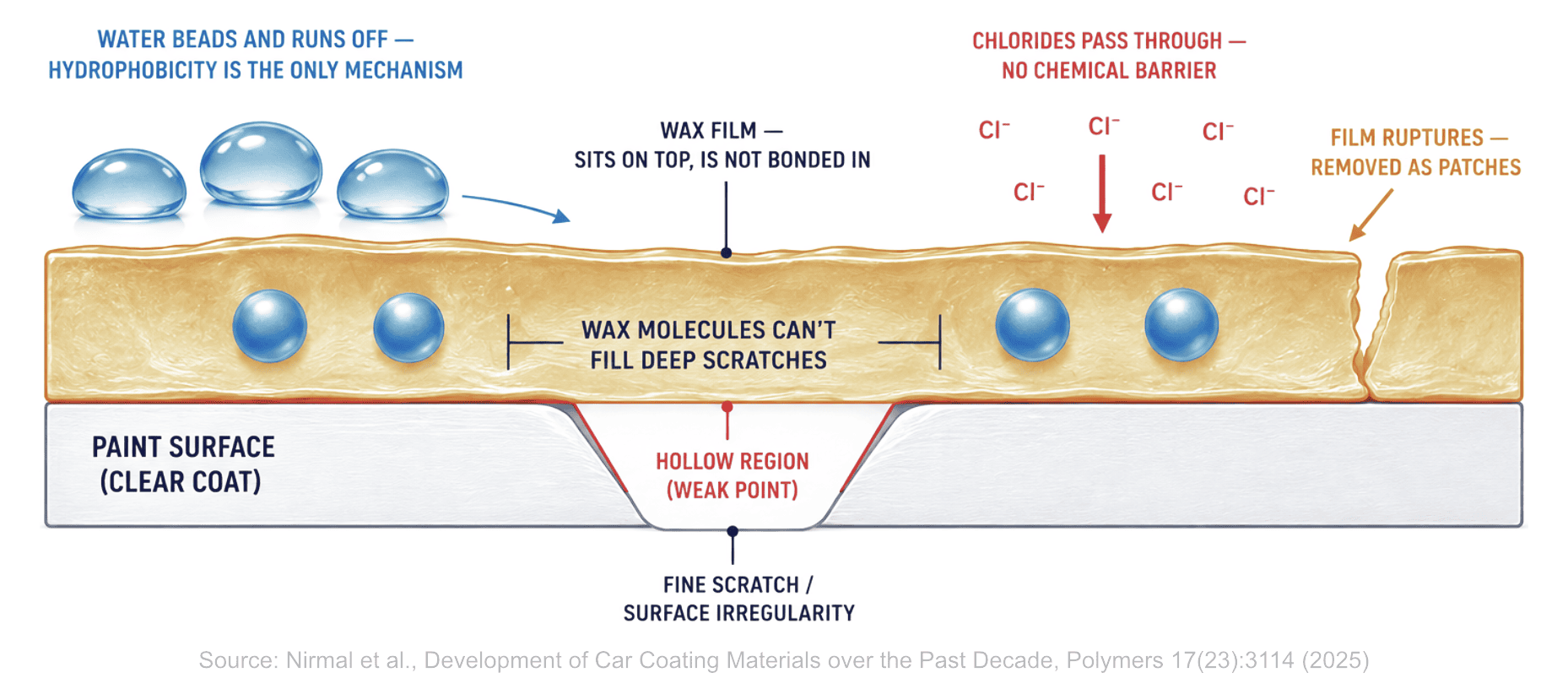
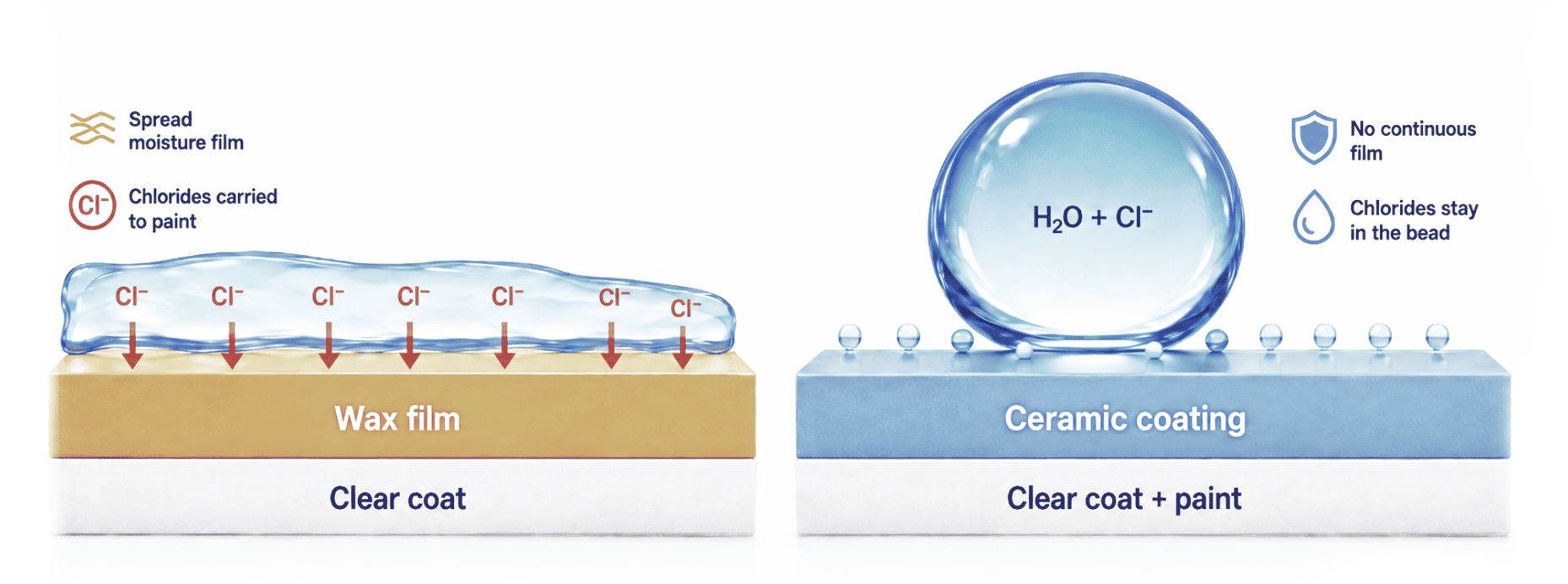
Wax is a physical film, not a chemical barrier. Its entire protective job is hydrophobicity: it lowers the paint's surface energy so water beads up and runs off instead of soaking in. That is the whole mechanism. The 2025 automotive paint-protection review in Polymers is blunt about the trade-off. Wax is popular because it's cheap and easy to apply, but its longevity is limited. The same review spells out how it fails. Wax films are "susceptible to erosion from detergents, rain, and UV degradation," and over time the film physically breaks apart, "removed as patches" that leave dull, unprotected spots across the panel. Wax never bonds to the paint. It sits on top of it. Even carnauba, the classic natural wax in paste formulas, "can be brittle in its pure form."
Freeze/thaw stress works directly against a film like that. Wax is built on paraffin and natural waxes, materials that expand and contract sharply with temperature. Thermal testing of paraffin waxes measures volume changes of 3.9–14.5% across the solid-to-liquid transition, with thermal expansion coefficients of 0.7–1.4 × 10⁻³ K⁻¹.

So every time a Seattle night drops below freezing and the afternoon climbs back into the 40s, the wax and the paint beneath it expand and contract at different rates. Repeat that across a winter of crossings past 32°F, and the mismatch keeps stressing a film that is already thinning and turning brittle with age and UV.

The damage that matters most happens underneath the wax. Wax gives no chemical resistance to chloride at all. Its protection is physical water repellency, not a barrier against salt. And chloride ions from road de-icers are small and highly mobile. They don't force through an intact film, they travel through pores and micro-cracks. Experiments on microcracked coatings are direct about what follows: "microcracks deteriorate the corrosion resistance. The corrosive solution can penetrate into the microcracks, resulting in the direct corrosion of the substrate." The part that should stop you is this: a coated surface with cracks running through it can corrode faster than bare metal with no coating at all. The broader coatings literature agrees. Chloride moves through the pore-and-crack network, and the coating's chemistry decides how deep it gets.
So the risk compounds. Wax fails by thinning, eroding, and flaking apart, and it does that at the worst possible time. The same freeze/thaw cycling that wears the film down is also opening micro-cracks in the clear coat beneath it, and those micro-cracks are the exact pathway that carries chloride down to the steel.

Once chloride reaches the clear coat through a micro-crack, wax or no wax, the electrochemical attack on the metal below begins.
What Ceramic Coating Does
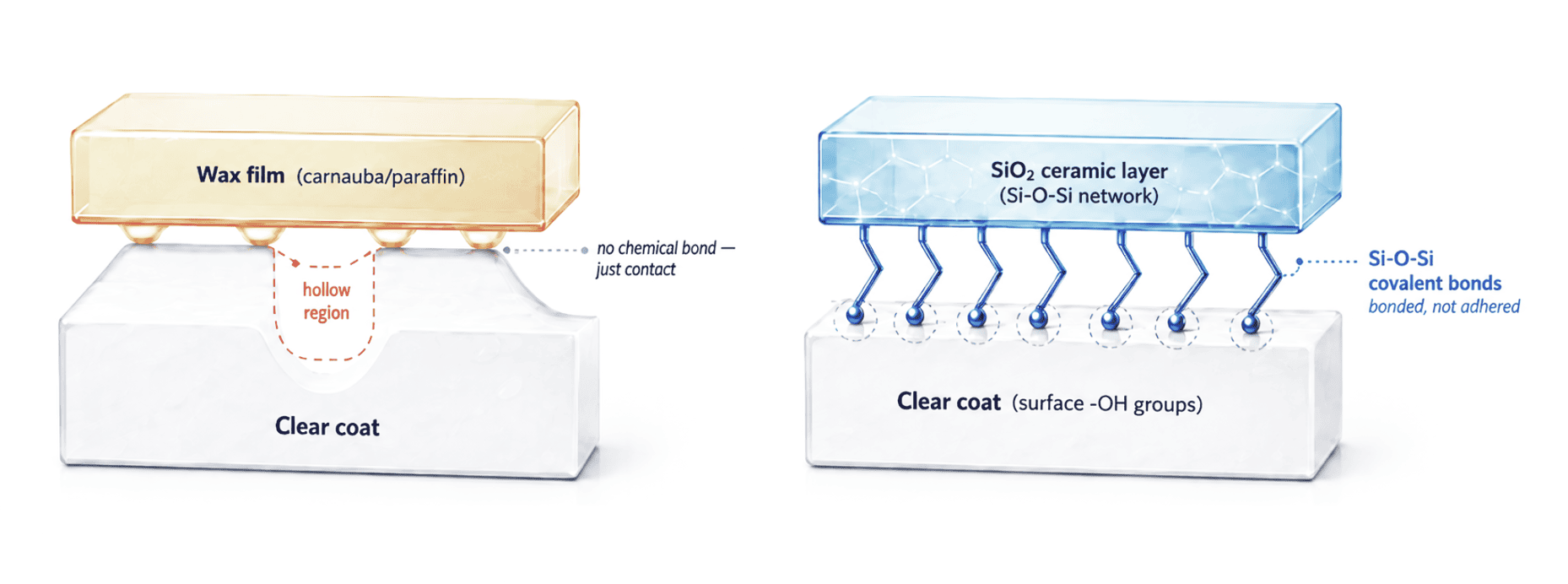
Ceramic coatings are built for the exact ways wax fails. Wax sits on your paint as a thin physical film. These coatings chemically bond to the clear coat, forming silica bonds that reach down into the paint's micro-pores and lock in. It isn't a layer resting on the surface waiting to wear off. It becomes part of the surface.

That bond is the whole difference. Wax holds on by physical grip, and physical grip is exactly what freeze/thaw cycling breaks. Ceramic coating bonds are chemical, so the daily expand-and-contract that peels wax away has nothing to pry loose. The ceramic network is also built to flex. It bends with the temperature swings instead of cracking under them, which is why it holds a level of thermal, wear, and corrosion resistance that wax chemistry can't reach.

No coating is a force field. Given enough time and neglect, any protection wears down. What SB3 changes is the matchup. Instead of a thin, eroding film with no chemical defense, chloride now runs into a layer that's bonded to the paint, flexes with the cold, and refuses to hold the water it needs to do its work. Over a Seattle winter, that's the difference between paint that's protected and paint that's quietly corroding.
Do you often park in the snow during Seattle Winters?
Ceramic coating protects against damage. It bonds directly to your clear coat, repels water instead of letting it pool, and holds up for years where wax wears out in weeks.

What This Means For Your Neighborhood

Freeze/thaw exposure isn't uniform across the service area. Elevation and commute route are the two variables that determine how much thermal cycling your vehicle accumulates.

Queen Anne

At 456 feet, Queen Anne is one of the highest residential neighborhoods in the service area. Sub-freezing nights are more frequent here than at waterfront elevation. The overnight freeze / midday thaw cycle that the research documents as the damage driver is a regular occurrence on Queen Anne throughout December, January, and February.
Joe Mabel, CC BY-SA 4.0, via Wikimedia Commons

Highland Park / Delridge

Elevated residential streets in Highland Park experience freeze events that the Duwamish Valley below escapes. Compounding factor: Delridge Avenue is a heavy truck route treated with road salt during freezing conditions. Vehicles parked in this corridor accumulate both bridge-grade chloride exposure from the arterial and the elevation-specific freeze/thaw cycling.

Mercer Island

I-90 crossing Lake Washington is one of WSDOT's highest de-icing priorities. Mercer Island residents who commute via I-90 are driving across treated bridge decks twice daily during freeze events — the most concentrated chloride exposure in the service area. The bridge exposure is independent of what the neighborhood streets look like.
Joe Mabel, CC BY-SA 4.0, via Wikimedia Commons

West Seattle

WSDOT treats the West Seattle Bridge as a high-priority surface during freeze events. Alki and Lincoln Park residents who commute via the high bridge encounter treated surfaces each time the temperature drops below freezing — whether or not the residential streets below them have been treated.

Explore More Ways
Seattle Damages Clear Coat

Seattle doesn't have dramatic weather. It has patient weather, which is worse for paint. 155 days of rain a year. A UV index too low to suppresses moss and bio-growth. Conifer sap dropping terpenes and rosin acids year-round. Marine salt aerosol off the Sound. All of these threats compound. Diamond Fox specializes in preventing it.
Persistent Rain
Salt ions in the moisture from the Puget Sound accelerate the electrochemical component of clear coat degradation and leave a residual deposit that traps additional humidity against the surface.
Conifer Sap
The PNW's conifer species drip resin year-round. Vehicles parked under or near these trees accumulate resin deposition that is genuinely continuous, and damaging to your vehicle's clear coat.
Airborn Fallout
Pollen is a seasonal but significant chemical threat. When pollen grains land on a vehicle surface and are exposed to moisture, they release mild organic acids, and biologically active compounds.
Moss and Bio-Growth
Year-round conifer fallout and pollen give colonizing organisms their perfect food source. They live on your car's surface and create enzymes that degrade your clear coat's molecular structure.
Road Contamination
Road salt, primarily sodium chloride, with calcium chloride and magnesium chloride used as liquid pre-treatment and anti-icing agents, creates a corrosive brine when it contacts moisture.

Frequently Asked Questions

A great result starts with a clear understanding of the process. These are the questions clients ask most often before handing over their keys. We want you to feel informed, comfortable, and confident from the start.

Because the damage isn't driven by how cold it gets. It's driven by how many times the temperature crosses the freezing threshold. A climate that stays at -20°F for three months creates one freeze event at the start of winter. Seattle's pattern of nights below 32°F followed by afternoons in the 40s creates 25 or more crossing events across the winter season. Each crossing creates a stress cycle: the clear coat expands as temperatures rise, contracts as they fall, and the interface between the coating and the substrate accumulates fatigue stress with each cycle. More crossings equals more cumulative fatigue, which is worse for the polymer network than fewer, deeper freeze events.

At road speed, tires generate significant throw-up. The spray pattern from a tire spinning at freeway speed throws material in a wide arc behind and beside the vehicle. De-icing brine applied to bridge and road surfaces is liquid. It atomizes under tire contact into a fine spray mist that travels with the vehicle. Adjacent and leading traffic creates additional spray from their tires. Vehicles crossing a treated bridge at 60 mph are driving through a sustained salt mist that contacts every exterior surface, not just the undercarriage, but hoods, roofs, trunks, and door panels. The undercarriage exposure is heavier. The paint exposure is real.

The chemistry is the same regardless of color. Chloride ions don't distinguish between black, white, and silver clear coat. However, salt damage manifests differently by color. On dark vehicles, white or gray salt residue is visible on the surface after a commute and easy to spot before washing. On white or silver vehicles, the residue blends with the paint color and is harder to see, which means it may sit on the surface longer before being noticed and addressed. Lighter-colored vehicles may accumulate more salt contact time simply because the deposits aren't as visually obvious as a reminder to wash.

Yes, prompt rinsing removes surface salt residue before it can concentrate as the water evaporates. For vehicles without protective coatings, this is the most effective maintenance step available: get the salt off the surface before it dries and before it can penetrate existing micro-damage in the clear coat. The limitation: rinsing removes surface salt but doesn't address salt that has already penetrated into existing micro-cracks in the clear coat or reached the metal substrate through previous coating failures. Rinsing is maintenance. It isn't repair.

Both are chloride-based and operate through the same electrochemical corrosion mechanism. Calcium chloride is hygroscopic: it actively draws moisture from the air, which means it stays wet longer on surfaces than sodium chloride, extending the period of chloride-ion mobility and surface contact. Calcium chloride is also effective at lower temperatures than sodium chloride, which is why WSDOT uses it for bridge deck applications where temperatures drop below the effective range of rock salt. For paint, the practical difference is that calcium chloride de-iced surfaces may leave a wetter, more concentrated residue that stays active on the paint longer after the commute ends.

There's no fixed threshold. The damage accumulates gradually and the visible result depends on the starting condition of the clear coat, any existing micro-damage, and what other threats are compounding simultaneously. A vehicle with thick, intact clear coat and no existing damage may show no visible effect after one winter. The same vehicle after three winters without protection will likely show progressive dullness and early surface roughness as the accumulated micro-crack network develops. By five or more winters, the surface roughness that provides contamination adhesion points accelerates every other threat. The damage is cumulative, not threshold-triggered.

Not necessarily. Chloride penetration through micro-cracks in clear coat is a slow process that often reaches the metal substrate before producing visible surface rust. The rust expansion that eventually causes paint bubbling or flaking (known as "paint blistering") requires the corrosion to have progressed far enough to volumetrically expand under the paint film. Early-stage chloride penetration at the metal level doesn't produce visible surface symptoms until the oxidation products have accumulated significantly. A vehicle that looks rust-free may still have early-stage electrochemical corrosion underway at the clear coat / metal interface, invisible from the outside.

A heated garage eliminates the overnight freeze portion of each cycle. If the vehicle freezes overnight outside, a heated garage would prevent that. But for most Seattle drivers, the overnight temperature isn't the only cycling source. The vehicle also goes from cold ambient overnight to engine-warmed during the commute, then back to cold if parked outside during the day. The thermal differential still exists across the commute. Heated garage storage reduces the number of freeze/thaw cycles the vehicle experiences but doesn't eliminate the differential that creates the stress. It's a meaningful benefit, not a complete solution.
DIAMOND FOX AUTO DETAIL

Explore our Services

Not every car needs the same thing. Some need a detail, some need correction, some need protection that actually holds up in Seattle, and some need all three in the right order. Explore what each service actually does and which one fits your car.

Auto Detailing

$249 starting
Financing Available
Deep cleaning, surface decontamination, and paint care. Because your ride deserves to shine.

Ceramic Coating

$1,299 starting
Financing Available
SB3 molecular protection bonded to your paint, built for what the PNW actually does to the clear coat.

Paint Correction

$349 starting
Financing Available
Swirl marks and lost depth measured, corrected, and restored. Paint depth gauge before every job.

New Car Protection

$899 starting
Financing Available
Seattle starts damaging new paint immediately. Ceramic coating protects before damage starts.
OUR CORE VALUES

The right people find Jesse.

A lot of people are searching for a quick solution. But the people who value the outcome know the difference between average work and the right hands on the job. Most people find a service. The right people find Jesse.
Precision
Precision is built through thousands of careful decisions over time. It’s knowing what matters, what doesn’t, and where exactness changes everything. When the work is done with precision, the result speaks for itself.
Integrity
You should know exactly what you’re getting and why it matters. Integrity is about being transparent, straightforward, and committed to the truth of the work. No shortcuts, no surprises, just honest service from start to finish.
Attention
Great results don’t happen by accident. They happen because someone is paying attention. From prep to final inspection, every part of the process is watched closely. That care shows up in the finish, and the confidence clients feel when it’s done.
Permanence
Permanence means building something that endures. The goal is lasting protection, lasting beauty, and lasting peace of mind for the owner. When the work is done with integrity, the results don’t just impress. They stay. That’s the Diamond Fox Standard.

Elite Level Service.
Done Right. The First Time.

For a vehicle you've invested in, ceramic coating is what separates a finish that holds up from one that fades, dulls, and demands constant upkeep.
Located in West Seattle at
7919 29th Ave SW
West Seattle, WA 98126
By Appointment Only
© 2026 Diamond Fox Auto Detail LLC. All Rights Reserved
Secret Link